press

While security integrators are in business to integrate security systems, often there’s nothing integrated about the business of security itself — from the central stations, interactive service providers and point solutions, to the myriad homegrown systems implemented and jury-rigged together over the years.
Unfortunately, this complex web of systems has resulted in multiple silos of business and customer data. Without the ability to collectively harness the information housed in these disparate systems, integrators are often blind to the rich insights that lie within their very own data. What’s more, this lack of integration can be frustrating for employees and customers alike, and especially for owners and managers who aren’t able to efficiently scale their businesses.
Such was the experience of Miles Fawcett, CEO of FieldHub Inc., Washington, D.C., when he started his security integration company in 2008. “I looked at the software available to run a business and felt a real gap,” he said. “My background was in software development … I had a clear vision of the product I wanted to use to build and grow my business, and I had relationships with software developers. I made the decision to build a platform for my company. I wanted something that could eventually be spun off and provide cloud-based services for other integrators.”
For the full article visit ADM Magazine’s Website
FieldHub MCP server · Limited release · Version 10.2.15
You can now ask FieldHub questions in plain language and get answers computed from your live data.
Connect Claude to your FieldHub account through a standard OAuth sign-in. No API keys, no configuration. Then ask.
MCP — Model Context Protocol — is an open standard for connecting AI assistants to systems. We built and tested against Claude first, including claude.ai connectors, Claude Code, and Claude Desktop. ChatGPT connectors are verified, and any MCP-compatible client can connect.
FieldHub, the all-in-one cloud platform for security, fire, and low-voltage integrators, is pleased to announce a new integration with fireNspec, the inspection management platform built for fire and life safety companies. The integration links inspection work to the rest of the business, so a customer or site entered in one system no longer has to be entered again in the other.
Most integrators run inspections and the business itself on different tools. The account lives in one place, the inspection lives in another, and staff spend time keying the same details into both and checking two systems to answer one question.
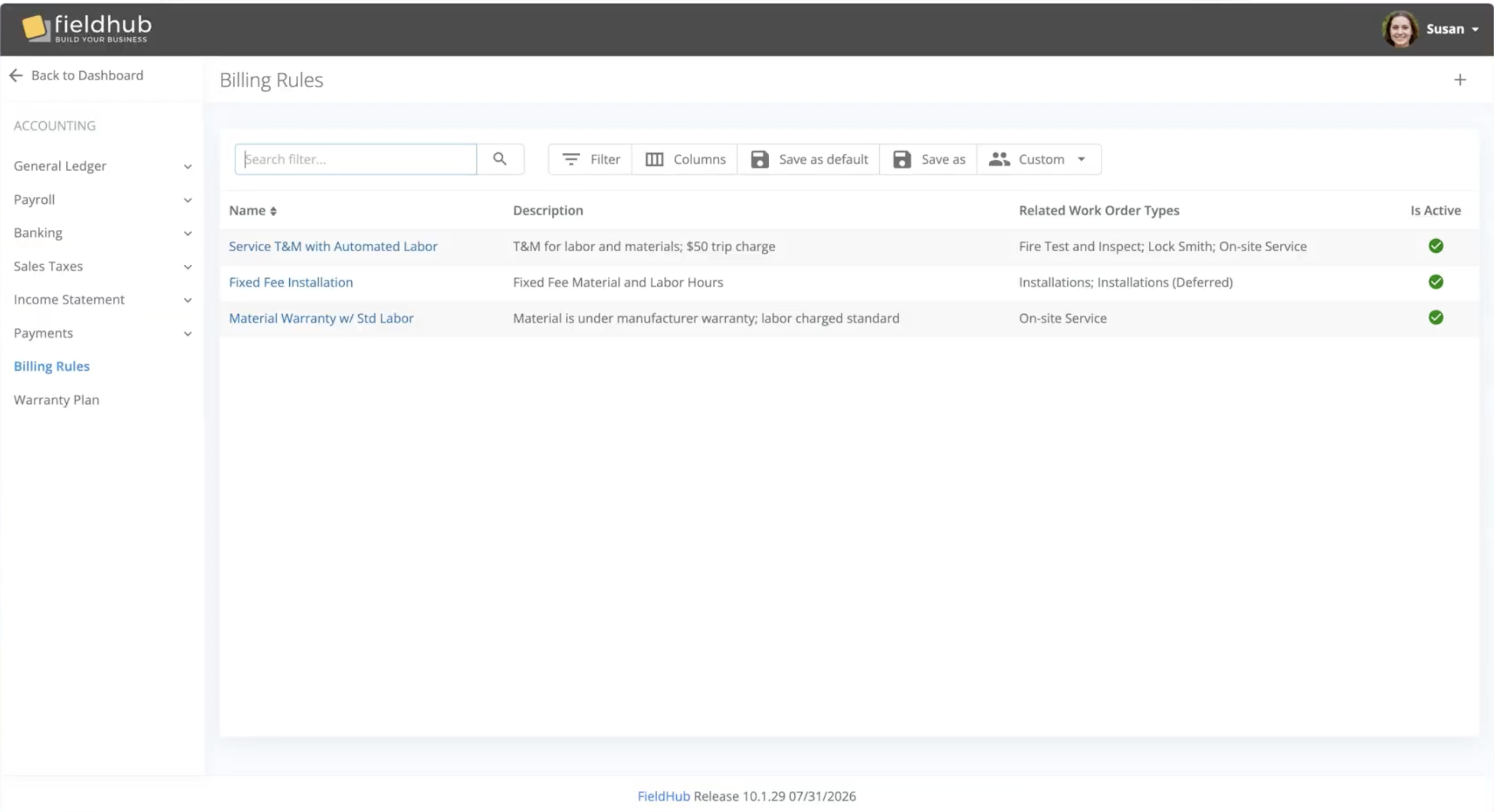
FieldHub has introduced Billing Rules, a new configuration engine that automates how labor, materials, and miscellaneous charges are priced and added to work order scope. Instead of a technician’s hours sitting as a gap to be filled in manually after every visit, Billing Rules writes the correct line — at the correct rate — into the work order the moment a work log is ready for invoicing.
Most platforms handle service pricing with static price books or a “service level” tag sitting off to the side of operations—a label that must still be manually translated into scope, line by line, by someone in the office.