features

With today’s global reality, we wanted to take the opportunity to share some of our favorite resources to help security installers acclimate to a remote working model.
From the very beginning, we built FieldHub around distributed teams. We have key team members in the US, Canada, and Europe. Even before launching FieldHub, I ran my security integration business, Urban Alarm, with distributed teams. From accounting and HR to provisioning video servers and IP cameras, our team members were dispersed across the globe. We shared one of our configurations for remotely provisioning IP gear in a previous post here.
In this post, we have collected the tools we’ve used over the years that have made this model a success.
We’re skipping file sharing and document creation since most organizations are using Microsoft 365 or Google which are both going to provide flexibility and functionality for a distributed team.
Photo Credit: Photo by Andrew Neel on Unsplash
FieldHub MCP server · Limited release · Version 10.2.15
You can now ask FieldHub questions in plain language and get answers computed from your live data.
Connect Claude to your FieldHub account through a standard OAuth sign-in. No API keys, no configuration. Then ask.
MCP — Model Context Protocol — is an open standard for connecting AI assistants to systems. We built and tested against Claude first, including claude.ai connectors, Claude Code, and Claude Desktop. ChatGPT connectors are verified, and any MCP-compatible client can connect.
FieldHub, the all-in-one cloud platform for security, fire, and low-voltage integrators, is pleased to announce a new integration with fireNspec, the inspection management platform built for fire and life safety companies. The integration links inspection work to the rest of the business, so a customer or site entered in one system no longer has to be entered again in the other.
Most integrators run inspections and the business itself on different tools. The account lives in one place, the inspection lives in another, and staff spend time keying the same details into both and checking two systems to answer one question.
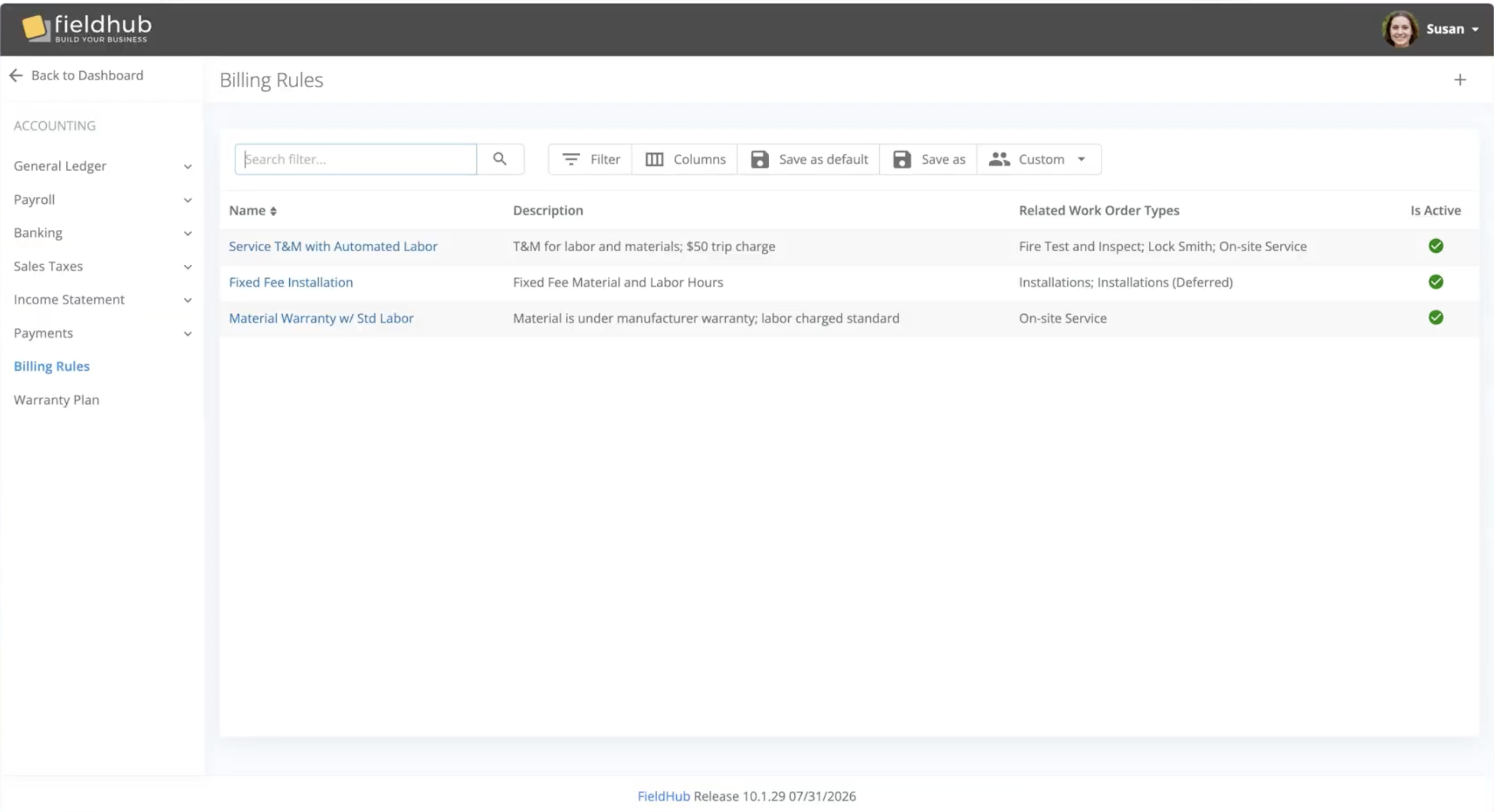
FieldHub has introduced Billing Rules, a new configuration engine that automates how labor, materials, and miscellaneous charges are priced and added to work order scope. Instead of a technician’s hours sitting as a gap to be filled in manually after every visit, Billing Rules writes the correct line — at the correct rate — into the work order the moment a work log is ready for invoicing.
Most platforms handle service pricing with static price books or a “service level” tag sitting off to the side of operations—a label that must still be manually translated into scope, line by line, by someone in the office.