Resources

A FieldHub Update – November 2025
At our Build25 user conference in Baltimore this October, one topic generated plenty of conversation: credit card processing fees and surcharges. Security installers and service providers are understandably looking for ways to offset the 2-3.5% they pay on every card transaction. But as we’ve dug deeper into this issue on behalf of our FieldHub community, we’ve discovered something unexpected: we still don’t have clear answers.
Following the 2024 Visa-Mastercard settlement, merchants can now surcharge credit card transactions to recover processing costs. Sounds straightforward, right? Add a fee, offset your costs, and move on.
But here’s where it gets complicated:
First, consider the fact that state-by-state regulations change what is permitted and how. If you only operate in a couple of states that happen to be permissive regarding credit card surcharges, this issue should be simple. But looking at the national landscape:
These rules appear to contradict each other. If you surcharge Visa and Mastercard credit cards but not debit cards (as federal law requires), American Express’s non-discrimination policy seems to prohibit accepting their cards. If you accept American Express and want to surcharge, you’d need to surcharge debit cards equally—which federal law prohibits.
We’re still working to understand how these policies reconcile in practice.
As we’ve researched this issue, we’ve encountered more questions than answers:
Enforcement questions: What are the actual penalties for non-compliance? How actively are card networks monitoring surcharge programs? What happens if you get it wrong? Will you lose the ability to process credit cards on a network completely?
Implementation questions: Are there approved workarounds we haven’t discovered? Do merchant agreements with specific processors offer more flexibility? Can you obtain waivers from American Express? Do you always know if a VISA or Mastercard is a credit card or a debit card?
State complications: Five jurisdictions still prohibit surcharging entirely (California, Connecticut, Massachusetts, Maine, Puerto Rico), though Oklahoma just legalized it in November 2025. New York permits it but has very specific requirements that you need to take into account not only on your invoices but also on how you present your proposals. How do multi-state businesses navigate this patchwork?
Real-world precedent: How are other security companies implementing surcharges? What’s working? What’s creating problems?
These aren’t rhetorical questions. These are questions that don’t have complete answers yet, and we’re concerned about recommending a path or implementing a technical solution that could expose our customers to compliance risks or penalties.
The math is compelling on the surface. For a security company processing $500,000 annually in credit card payments:
That’s real money. But it has to be weighed against:
Without clear guidance on the penalty side of this equation, it’s hard to make an informed recommendation.
While we’re still working through the credit card surcharge puzzle, there’s a solution that benefits everyone and involves zero pricing compliance headaches: ACH payments.
ACH transactions typically cost merchants a fraction of the 2-3.5% for credit cards. Better yet:
For recurring monthly monitoring and RMR, ACH is particularly well-suited. FieldHub’s platform supports ACH processing, automated collection sequences, and can help you transition customers from cards to bank payments.
We’re not giving up on understanding the credit card surcharge question. We’re:
In the meantime, we’re focusing on helping FieldHubbers implement ACH payment strategies that deliver immediate savings without compliance uncertainty.
For those who want to dive deeper into the credit card surcharge landscape:
If you’re interested in exploring ACH implementation for your business, reach out to your FieldHub account manager. We’re here to help you navigate payment processing in a way that makes sense for your business.
This article is for informational purposes only and does not constitute legal or financial advice. Consult with qualified professionals before implementing any payment processing changes.
FieldHub offers an all-in-one, cloud-based platform built specifically for security system installation professionals. This comprehensive Software-as-a-Service (SaaS) solution streamlines lead and proposal management, project coordination, field service operations, and inventory tracking. FieldHub also automates recurring billing and revenue recognition for recurring or deferred revenue—while providing a complete accounting system. For more information, visit fieldhub.com.

FieldHub MCP server · Limited release · Version 10.2.15
You can now ask FieldHub questions in plain language and get answers computed from your live data.
Connect Claude to your FieldHub account through a standard OAuth sign-in. No API keys, no configuration. Then ask.
MCP — Model Context Protocol — is an open standard for connecting AI assistants to systems. We built and tested against Claude first, including claude.ai connectors, Claude Code, and Claude Desktop. ChatGPT connectors are verified, and any MCP-compatible client can connect.

FieldHub, the all-in-one cloud platform for security, fire, and low-voltage integrators, is pleased to announce a new integration with fireNspec, the inspection management platform built for fire and life safety companies. The integration links inspection work to the rest of the business, so a customer or site entered in one system no longer has to be entered again in the other.
Most integrators run inspections and the business itself on different tools. The account lives in one place, the inspection lives in another, and staff spend time keying the same details into both and checking two systems to answer one question.
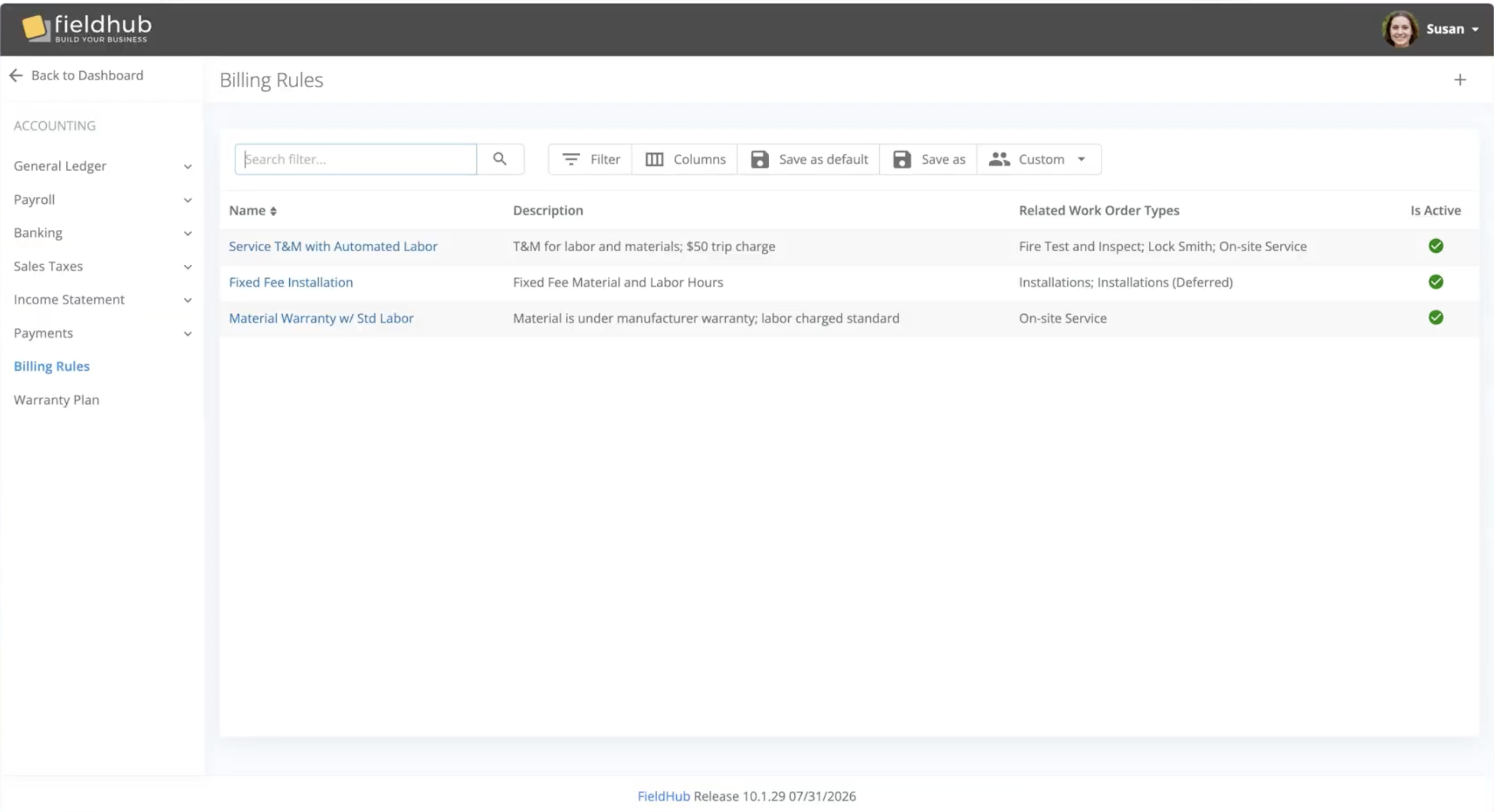
FieldHub has introduced Billing Rules, a new configuration engine that automates how labor, materials, and miscellaneous charges are priced and added to work order scope. Instead of a technician’s hours sitting as a gap to be filled in manually after every visit, Billing Rules writes the correct line — at the correct rate — into the work order the moment a work log is ready for invoicing.
Most platforms handle service pricing with static price books or a “service level” tag sitting off to the side of operations—a label that must still be manually translated into scope, line by line, by someone in the office.