
Bring call activity into your field service and security operations.
Phone calls are still central to how field service and security integration teams work. But when calls live only inside a phone system, important context is often lost—especially during handoffs, follow-ups, and scheduling changes.
FieldHub’s RingCentral integration connects phone communication directly to FieldHub, so call activity is visible alongside the customer records and workflows your team already uses.
Many teams manage phone calls in one system and operations in another. That separation makes it harder to track conversations, document outcomes, and maintain accurate customer history.
Without a direct connection between phone calls and operational records, teams rely on manual notes and memory. Over time, this leads to extra administrative work, missed details, and reduced visibility across office and field teams.
The RingCentral integration brings call activity into FieldHub, linking calls directly to customer records. Teams can see call history and context without switching systems or searching through separate tools.
By keeping phone communication inside FieldHub, conversations become part of the operational record. This gives teams a clearer, more complete view of customer interactions and supports more consistent follow-through.
Watch the short video walkthrough below to see how RingCentral call activity appears in FieldHub and how teams can access call history directly from customer records.
FieldHub MCP server · Limited release · Version 10.2.15
You can now ask FieldHub questions in plain language and get answers computed from your live data.
Connect Claude to your FieldHub account through a standard OAuth sign-in. No API keys, no configuration. Then ask.
MCP — Model Context Protocol — is an open standard for connecting AI assistants to systems. We built and tested against Claude first, including claude.ai connectors, Claude Code, and Claude Desktop. ChatGPT connectors are verified, and any MCP-compatible client can connect.
FieldHub, the all-in-one cloud platform for security, fire, and low-voltage integrators, is pleased to announce a new integration with fireNspec, the inspection management platform built for fire and life safety companies. The integration links inspection work to the rest of the business, so a customer or site entered in one system no longer has to be entered again in the other.
Most integrators run inspections and the business itself on different tools. The account lives in one place, the inspection lives in another, and staff spend time keying the same details into both and checking two systems to answer one question.
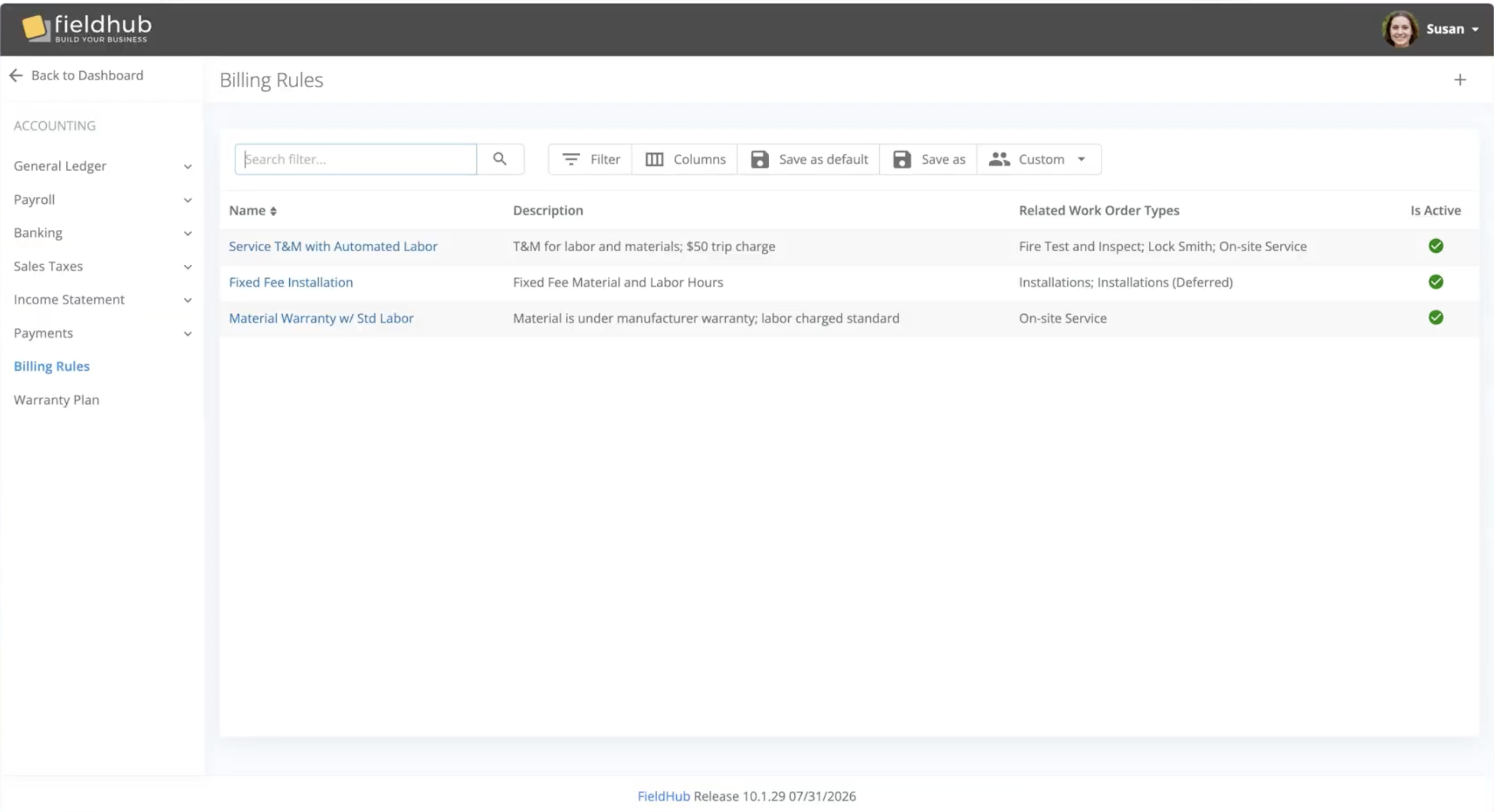
FieldHub has introduced Billing Rules, a new configuration engine that automates how labor, materials, and miscellaneous charges are priced and added to work order scope. Instead of a technician’s hours sitting as a gap to be filled in manually after every visit, Billing Rules writes the correct line — at the correct rate — into the work order the moment a work log is ready for invoicing.
Most platforms handle service pricing with static price books or a “service level” tag sitting off to the side of operations—a label that must still be manually translated into scope, line by line, by someone in the office.