resources
You’d never sign a 3-year lease on a building you’ve never walked through. Why do that with your software?
Most software companies want to close the deal. We want to make sure the deal should close.
A failed implementation costs everyone—your team loses time and trust, and we lose a customer who should never have been one. The pilot exists to prevent that. Before either side commits, we work together to confirm that FieldHub aligns with your needs, your expectations, and your operational reality. If the fit is right, the project is set up for success before it even begins. If it’s not, we’d rather you know now.
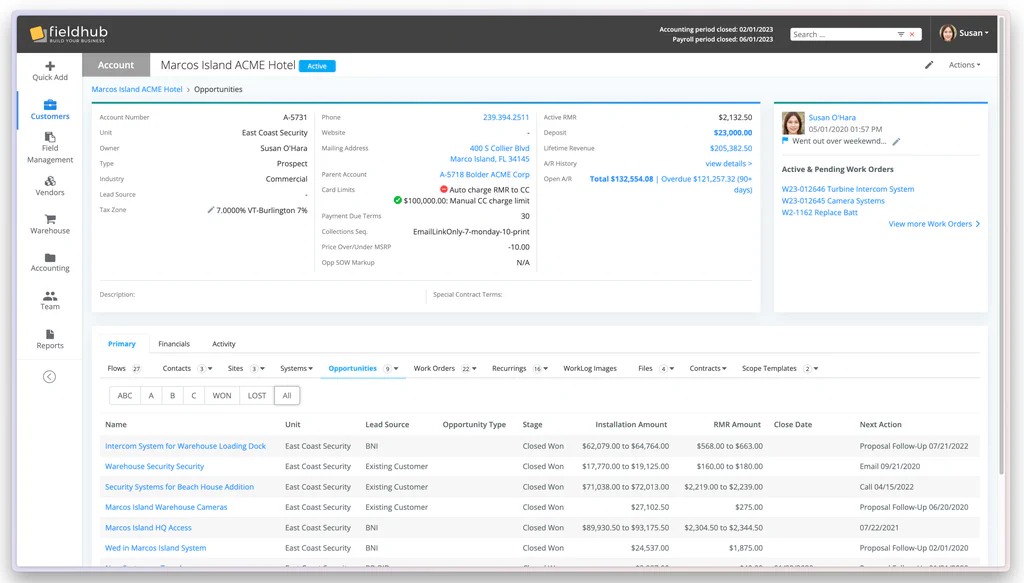
FieldHub gives you a fully functional sandbox environment with your workflows, your terminology, and simulated data you can actually work with. You dispatch jobs, generate invoices, run reports, and navigate the system the way your team would use it every day.
This isn’t a sandbox with a countdown timer. It’s a working copy of FieldHub where you pressure-test the platform against the way your company actually operates.
Your Own FieldHub Environment: You get access to a pre-populated instance of FieldHub with realistic data—service agreements, work orders, customer records, inventory. Work jobs through the system, close them out, and see what happens downstream in accounting and reporting. Every module. No restrictions.
Structured Weekly Sessions: Over 6 to 8 weeks, you meet with our implementation team once a week. Each session covers a specific area of the platform—scheduling, dispatching, invoicing, reporting, inventory, accounting—tailored to the way your company works. Between sessions, you have time to configure, explore, and compile questions for the next meeting.
Change Management, Not Just Training: The pilot isn’t just about learning software. It’s about identifying the workflow changes your team will need to make and planning for them before go-live. You’ll know which processes will change, which will improve, and where your team may need support—before you bring everyone in.
Full Team Onboarding: Once your leadership team has configured the system and understands the platform, you bring in your entire staff for hands-on training. By that point, the hard decisions are made. Your team learns a system that’s already set up for the way you work.
Switching operational software is a big decision. You’re moving your scheduling, your accounting, your customer records, and your field operations into a new system. We think you should know exactly what that looks like before you start—and we need to understand your operation well enough to set it up right.
The pilot is where alignment happens. It’s where we learn how your business actually runs, and where you see whether FieldHub supports that reality or fights it. That mutual understanding is what separates a successful implementation from a painful one.
The pilot lets you answer the questions that matter most before you commit:
Does this work the way we work? You’ll run your actual workflows—not watch someone else run theirs.
What changes will our team need to make? Every new system requires some adjustment. The pilot gives you time to identify those changes and plan for them.
Is the data migration worth it? Migration takes effort. The pilot gives you the context to weigh that effort against what you’ll gain.
Are we aligned on what success looks like? By the end of the pilot, both sides know the scope, the timeline, and the expectations—so go-live isn’t a leap of faith.
“You can really get in there and work the jobs through, the invoices through, whatever module you would use. You can actually do it with their software—which is so valuable because you can truly see if it’s something that would work for you.”
“It was a slower process and it was a long process, but it was thorough. It made sure that you really got to get in there and make the correct choices for your company.”
“The experience I’ve had with FieldHub’s customer support has been some of the best support I’ve ever received from another company.”
-Amanda Malloy, Operations Manager, JM Resources
The pilot is the first phase of a structured implementation process. Here’s what the full timeline looks like:
Pilot Phase (6–8 weeks): Access your environment, meet weekly with our team, configure the platform, and validate that FieldHub fits your operation.
Data Migration: We work with you to move customer records, service agreements, GL history, and inventory data. This takes time—and we’re upfront about that—because getting it right matters more than getting it fast.
Full Team Training: Your staff learns a system that’s already been configured for your business, not a generic install.
Go-Live and Support: Our team stays close through your first billing cycles, first dispatches, and first month-end close to make sure the transition holds.
The pilot is how you find out if FieldHub fits—and how we confirm we can deliver. No pressure, no ambiguity. Get into the system, do the work, and decide with confidence.

Bring Zoom call activity into your operational workflow.
Calls and virtual conversations play an important role in how field service and security integration teams coordinate work. But when those conversations stay inside Zoom, critical context can be lost once the call ends.
FieldHub’s Zoom integration connects call activity directly to FieldHub, making it easier to reference conversations, maintain accurate customer records, and keep teams aligned—without adding manual steps.
Bring call activity into your field service and security operations.
Phone calls are still central to how field service and security integration teams work. But when calls live only inside a phone system, important context is often lost—especially during handoffs, follow-ups, and scheduling changes.
FieldHub’s RingCentral integration connects phone communication directly to FieldHub, so call activity is visible alongside the customer records and workflows your team already uses.
FieldHub, the all-in-one, cloud platform for security and field service businesses, and Rapid Response Monitoring, the industry’s leading provider of professional In-Facility Monitoring, are pleased to announce a new integration that streamlines the creation and ongoing management of monitored subscriber accounts—right from within FieldHub. The integration helps dealers reduce double entry, accelerate job closeouts, and keep service quality tight across the full lead-to-invoice lifecycle.
With FieldHub’s Systems Management capabilities, dealers can perform central-station actions without leaving the platform—including creating central station accounts from account/site details, placing systems on and off test, and activating/deactivating systems—so field operations, billing, and account records stay in sync.