features
FieldHub MCP server · Limited release · Version 10.2.15
You can now ask FieldHub questions in plain language and get answers computed from your live data.
Connect Claude to your FieldHub account through a standard OAuth sign-in. No API keys, no configuration. Then ask.
MCP — Model Context Protocol — is an open standard for connecting AI assistants to systems. We built and tested against Claude first, including claude.ai connectors, Claude Code, and Claude Desktop. ChatGPT connectors are verified, and any MCP-compatible client can connect.
Nine business domains, forty object types. Some examples:
| Domain | Ask it |
|---|---|
| Receivables | Which customers are more than 90 days overdue, and when did we last contact them? |
| Recurring billing | What is Acme Security’s RMR today, and what is our total across the book? |
| Bookkeeping | Build the Q2 income statement by business unit, then show me what makes up General Admin for the Northwest Business Unit. |
| Scheduling | Who is scheduled tomorrow, where, and for which customer? |
| Work orders | What’s sitting uninvoiced right now? |
| Flow | Which processes are stuck, and who’s holding them? |
| Purchasing | What Purchase Orders are still open with this vendor? |
| Activity | What changed this week, and who changed it? |
Every major object can be searched, filtered, fetched by ID, and aggregated — count, sum, average, grouped by up to two dimensions and filtered by date.
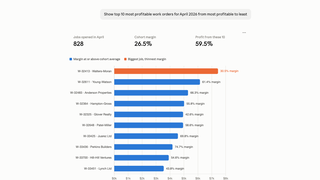
Balance sheet, income statement, cash flow, trial balance, chart of accounts, register balances. Drill down from any number to the entries behind it.
Most field service software can’t do this. The ledger lives in a separate accounting system, so the platform hands you off. FieldHub’s general ledger is native. The assistant reads the same ledger your controller does.
“The thing that stood out immediately was the GL drill-down. We were able to go from an income statement line, to the supporting entries, to the journal transaction, and then back to the originating work order and warehouse document in three calls.” — Justin Wehrheim, VP and General Manager, Security Install Solutions
Sixteen write actions shipped in this release:
Every write stops first. The assistant shows what it’s about to do and waits for you to confirm. Everything else is read-only.
“Overall, this has been a major time saver for me, roughly 5-7 hours this week alone.” — Justin Wehrheim, VP and General Manager, Security Install Solutions
Limited release. We’re inviting customers in deliberately so we can stay close to how it’s being used.
What you’ll need. The MCP server connects FieldHub to an AI platform and model you already have, such as an Anthropic Claude subscription. That subscription is separate from FieldHub and is not included with it.
Not on FieldHub yet? This works for the same reason job costing and deferred revenue work — one system, one ledger, nothing to reconcile between them. Request a Demo
FieldHub, the all-in-one cloud platform for security, fire, and low-voltage integrators, is pleased to announce a new integration with fireNspec, the inspection management platform built for fire and life safety companies. The integration links inspection work to the rest of the business, so a customer or site entered in one system no longer has to be entered again in the other.
Most integrators run inspections and the business itself on different tools. The account lives in one place, the inspection lives in another, and staff spend time keying the same details into both and checking two systems to answer one question.
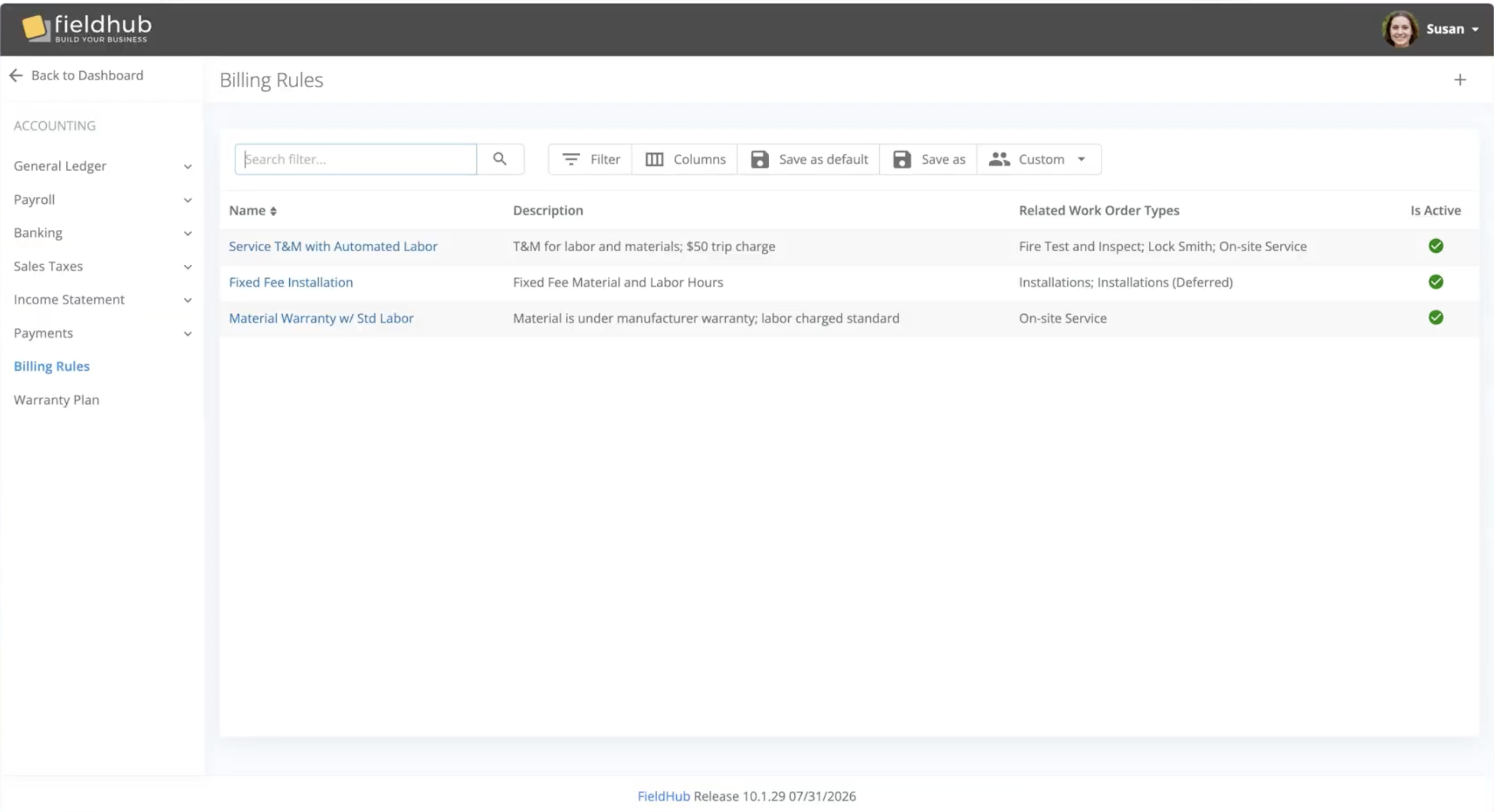
FieldHub has introduced Billing Rules, a new configuration engine that automates how labor, materials, and miscellaneous charges are priced and added to work order scope. Instead of a technician’s hours sitting as a gap to be filled in manually after every visit, Billing Rules writes the correct line — at the correct rate — into the work order the moment a work log is ready for invoicing.
Most platforms handle service pricing with static price books or a “service level” tag sitting off to the side of operations—a label that must still be manually translated into scope, line by line, by someone in the office.
You’d never sign a 3-year lease on a building you’ve never walked through. Why do that with your software?
Most software companies want to close the deal. We want to make sure the deal should close.
A failed implementation costs everyone—your team loses time and trust, and we lose a customer who should never have been one. The pilot exists to prevent that. Before either side commits, we work together to confirm that FieldHub aligns with your needs, your expectations, and your operational reality. If the fit is right, the project is set up for success before it even begins. If it’s not, we’d rather you know now.